

“Change Resistance” Isn’t Resistance At All
Change Isn't the Problem. Surprise Is.
Having spent my career working in the world of change, I know a thing or two about it, and it bothers me endlessly when I hear other change professionals still referring to what is fundamentally a natural reaction to a loss of control as resistance. (FWIW *It’s more complex than just a loss of control, but it’s a strong starting point.)
If I wanted to be a little provocative, I might even say there is really no such thing as resistance to change.
Picture this: you're sitting in an all-hands when suddenly you vaguely register "we're integrating a new system for XYZ, and we're so excited about the possibilities and efficiencies this will open up for us."
Wait… What?
You take a beat. You’re starting to breathe a little more rapidly, your brain is on the fritz and you know that someone is still talking — droning on for all intents and purposes — but you're stuck because all your brain hears is "danger alert — danger alert — danger alert.”
Calling It Resistance Isn’t Helpful When It’s Biology Doing It’s Thing
Now, if you’re reading this blog, you might be someone who is a change practitioner… or you might be a leader who is trying to figure out the best way to navigate a new change initative you’re responsible for. If so you’re maybe not looking to go where this is going. But I promise, stay with me for a minute and you’ll not only understand there’s a reason why I share it, but you’ll also get some ideas of what it is / what to do instead.
Few people at work set out to be troublesome, and even fewer delight in being “difficult”. Rather, most people, just want to show up, do a good job, and feel like they’re both contributing meaningfully to something while being appreciated for doing it. When we layer in how change can manifest, and the organizational culture where the change is taking place - even the most committed people may be caught off guard.
If Not Resistance, Then What?
Consider what the term resistant implies. What feelings, colors, sensations, words come up for you when you mull over the word “resistant”?
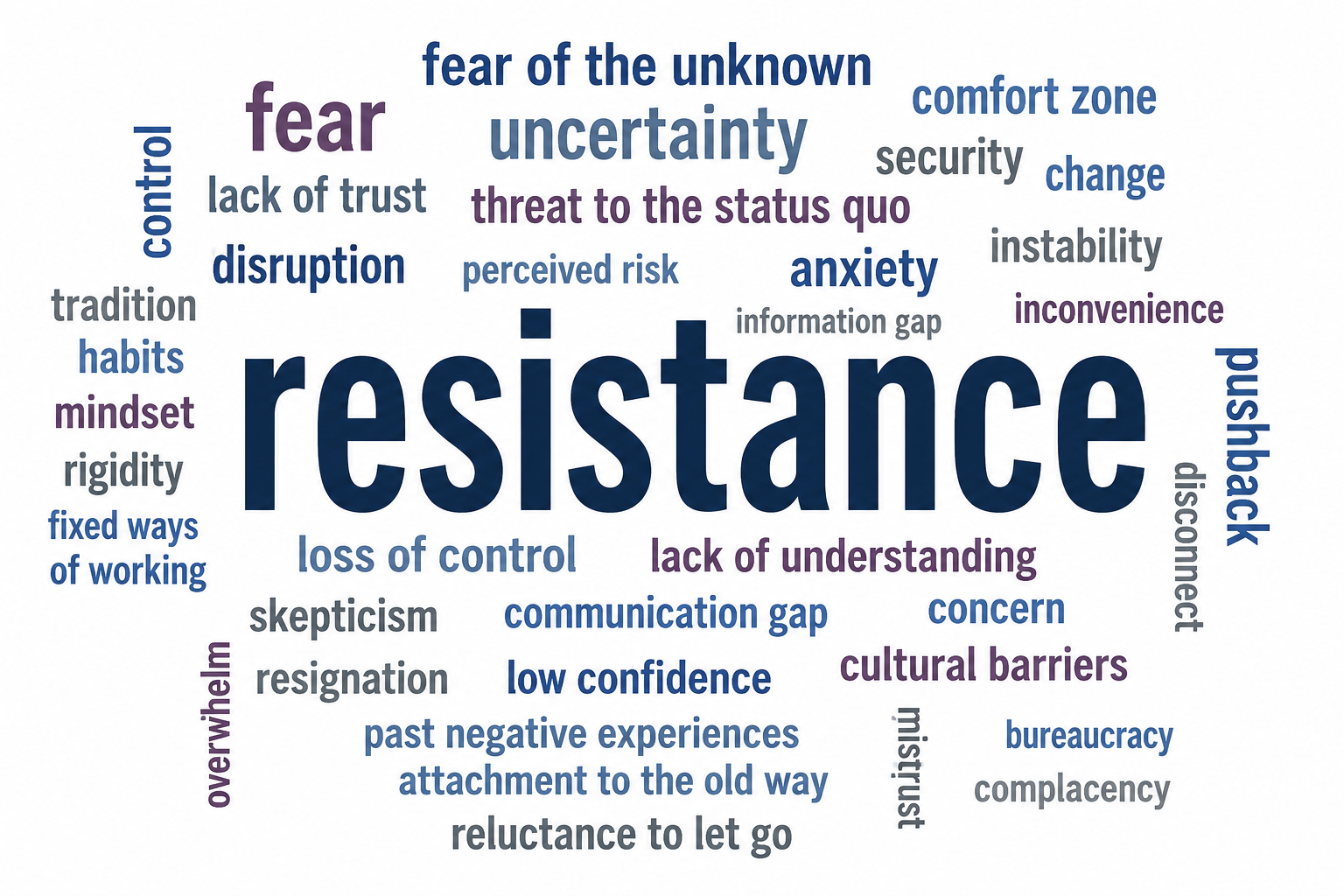
Word Cloud Associated with the Word Resistance
This visual perfectly illustrates why the word "resistant" is so problematic. It's a label that carries so much judgment (stubborn, defiant, difficult) while masking the fear, anixety, worry and loss of control, that is happening.
Let’s imagine we’re in that all hands meeting again… we hear the announcement, and our brain and body are reacting to surprise. It isn’t so much that people don’t tolerate change well, it’s more that the shock of it is destabilizing. Our nervous systems are designed to protect us from uncertainty, because from an evolutionary standpoing, uncertainty meant threat to our very existence. Even though change may not be the same level of existential threat - when it arrives (at least at first)- the reason you get fuzzy or short circuit is because the brain is adapting to a perceived threat and is trying to protect you. What happens next in the sequence might look like challenging, avoidance, or blocking. These are the behaviours that often make it look like people may be resisting change, but behind every outward behaviour, there is a nervous system negotiating emotional responses to discomfort. (Schwartz-Hebron, R. (2026). Advanced Applied Neuroscience Foundations Course [Online course]. KCI Certification. https://www.kcicertification.com.)
Let me say that again. There is no resistance to change, there is only behaviour behind which lies immense emotional discomfort. Unless there are well developed skills to navigating our emotional discomfort, our bodies will respond in the way they have learned to respond throughout our lives, and try as we might - this is not something we can control. (So we can throw away the idea that we just need to respond instead of reacting. Our brains work so quickly that when threat is registered, and the brain is flooded with stress hormones - the pre-frontal cortex goes offline. (Refresher: the PFC is the part responsible for planning, analysis, deliberation, decision making, logic and reason.) And what is left when the pre-frontal cortex is unaccessable, is operation from survival instinct and often, less than stellar response patterns.
[For clarity- this sequence has been simplified for the sake of getting to the point.]
This is why it bothers me so much that the word resistance is so widely used and accepted. Resistance implies intent, but when the behaviours linked to emotional discomfort arise (which are triggered on the basis of perceived inescapable threat, and the loss of control associated with it), we're just seeing the outward manifestations of a nervous system (that has also, at least temporarily lost control) trying desperately to regain it in any manner it can.
When Behavioral Economics Adds An Extra Layer
A few years ago I went down a rabbit hole on behavioral economics — specifically loss aversion and status quo bias. Loss aversion is the knowing that people will work harder to avoid losing something than to gain an equivalent thing. Status quo bias is that we prefer the known, even if it's not great, over the unknown that might be better. This is why people hold onto bad jobs, bad relationships, etc., it’s because the loss of the known feels bigger than the gain of the unknown. (Bonus? This tracks with the neuroscience that the brain is registering a perceived loss of control and does not like it!)
So What and Now What?
Knowing the background, we can now move into that we can do about it. Other than naming that when we want change to land, we have to address the surprise element first. Then we have to address the perceived loss of control, and we have to do it all at scale.
This is where complex adaptive systems thinking can help us.
Organizations are organic living networks, and they adapt through relationships and feedback loops. No linear step-by-step process (e.g. communicate, roll it out, enforce compliance, measure adoption) is going to be able to address the complexity of the living network. We’re foolish when we try. Assuming mechanistic structure in an organic reality, we’re butting up against the very nature of how living (human) systems actually function.
Change that works accepts non linearity and tends to do things differently.
If organizations are living networks that thrive on relationships and feedback loops, then the appropriate response to perceived loss of control and emotional discomfort shouldn’t be a top-down broadcast with disagree and commit rhetoric. The more suitable response will work with how the system actually moves information and influence distributed across a network.
Neither linear nor one and done
Create feedback loops with visible effects in the system.
A complex adaptive system self-organizes around what it can sense and respond to. It is also intelligent. If we open input channels but nothing visibly changes as a result, the network internalizes that input doesn't matter, and distrust takes root. To mitigate this, we recommend picking specific, bounded decisions that are still open, gather input on those, and make the resulting change visible. The visible change shows the feedback loop closing, and is what signals to the network that the loss of control, influence and agency might not be anything to worry about after all. When people have a hand in creating what is new , it transforms the story from “something is being done to me” into “I have a voice and I’m part of the change”.
A word of advice: when picking something that is still open to influence, make sure it matters. The room will know when they’re being hoodwinked, and the exercise WILL backfire. Also, acknowledge limitations to what is open to influence explicitly. Acknowledging what is fixed and what is fluid in the change allows for integration of the message better, than when people are kept in the dark. Ambiguity creates noise, and noise compounds as it spreads through relationships. People fill gaps with their own interpretations, and those interpretations propagate. Frequently clarifying what's fixed versus what's still being shaped (open for input) reduces the noise the network has to process, and reduces the compounding effect of unclear information across the system. Uncertainty breeds narratives of ill intent, and you do NOT need that.
Build in deliberate pacing, even when there's pressure to move fast. Scale often pushes toward speed and efficiency, but the living networks don’t move all at once, and need time to process and integrate the message at their own pace. In practical terms, this looks like staggered implementations across teams, with built in checkpoints, and respect for local pacing that lets the network metabolize the change it naturally would, rather than forcing artificial uniformity. This requires patience. Lots of patience. Fight the urge to compress the timeline just because the org is large and things need to keep going. The cost of going too fast increases with the number of people who feel rushed, and risks the system pushing back or fragmenting under pressure. (Rushing and pressure sends a message that will undo all of the positive gains from involving people - it overwhelms the system's capacity to self-organize and integrates as “done to me”, even if they’ve had a say.)
Work with the relational structure that already exists, rather than building parallel structures. The network's actual influence pathways run through managers and local relationships in a way that org-wide announcements can’t replicate. It’s critical to equip the people already embedded in those relationships (managers) to recognize what's happening in their teams, create space for input on the bounded decisions, and close feedback loops locally. This works with the network's existing topology instead of trying to overlay a new one, and it tracks how agency and safety actually get restored. Our nervous systems regulate in connection with other regulated nervous systems. A manager who is present, who respects what is alive while also creating space for self organization within set boundaries, is doing co-regulation.
If you do all those things, and Resistant Behaviours Still Surface — Pay Attention
Behaviour resulting from emotional discomfort at times of change is valuable information. Treat it as data and get curious about what you see instead of trying to manage, reduce or ignore it. Look for what's not being said beneath the behaviour.
Sources:
Schwartz-Hebron, R. (2026). Advanced Applied Neuroscience Foundations Course [Online course]. KCI Certification. https://www.kcicertification.com
Arnsten, A.F.T. (2009). "Stress signalling pathways that impair prefrontal cortex structure and function." Nature Reviews Neuroscience, 10(6), 410-422.
Edmondson, A.C., The Fearless Organization, 2018.
Wheatley, M.J. (2006). Leadership and the New Science: Discovering Order in a Chaotic World. Berrett-Koehler Publishers.
Porges, S.W. (2011). The Polyvagal Theory: Neurophysiological Foundations of Emotions, Attachment, Communication, and Self-Regulation. W.W. Norton & Company.
Sapolsky, R.M. (2004). Why Zebras Don't Get Ulcers. Holt Paperbacks.
Kahneman, D. (2011). Thinking, Fast and Slow. Farrar, Straus and Giroux.