

Change Enablement vs. Change Management
I’m often asked what I do for work. Emphatically, I say “I’m a Change Enablement Consultant!” At this, I tend to get a confused look and a quick follow up with "what’s that?". The frequency of this question could go head to head with the amount of times my name gets mispronounced, and that's a lot. So I figured I’d take some time and explain it in case there were more people out there wondering the same thing.
Change This, Change That
As I was writing this, I started pondering whether if I said “change initiative” - that would resonate in the same way that something like “project” would. Though I distinctly avoid using the term project in conjunction with my work, it is (unfortunately) how the field of Change Management has evolved to be perceived. Change management is so much more than just a support function to project management, and traditionally change managers did far more than comms and training. I can’t rewind the history, nor might I want to - there is benefit that comes from specific task oriented change support, but if that’s all we think the field of change does - we’re doing ourselves a disservice, and robbing our organizations of an opportunity to get So. Much. More.
Alas, a change initiative is a deliberate sponsored effort to move a defined group (a team, a function, or even an entire organization) — from where they are, to where the organization determined it needs to be to achieve its outcomes – with a scope, an objective, and a timeframe (even if that timeframe is elastic.)
A change initiative can be a project, but that’s the tip of the iceberg as it relates to change initiatives. Where projects are usually technical or operational deliverables, the change initiative is the people-side shift wrapped around that deliverable, and that includes changes in how people work, decide, and relate to each other. A project can succeed (on time, on budget, technically complete) while the change initiative around it fails completely.
Change initiatives therefore will generally include changes in practices, processes, structure (even if informally so) - and might sometimes even require changes in mindsets, rewards systems and ultimately, culture (defined as “how we do things around here”).
The History Books
I have a masters degree in change management from way before Prosci infiltrated the field. I never had any issues with the area I studied until I went into the corporate landscape and started hearing things like “oh, that’s something we need to change manage”. In case you’re not familiar, that is corporate speak for we have a person who isn’t getting on board, and they need to be managed.
I have heard it so much over the years, that in conjunction with the very limited scope that Change Managers now have, I’ve moved away from seeing myself as that. I’ve grown my own change practice to have a toolkit that includes understanding human behaviour through psychology, neuroscience, behavioural economics, that leverages complexity theory and systems thinking - and that is based on years and years of testing and learning.
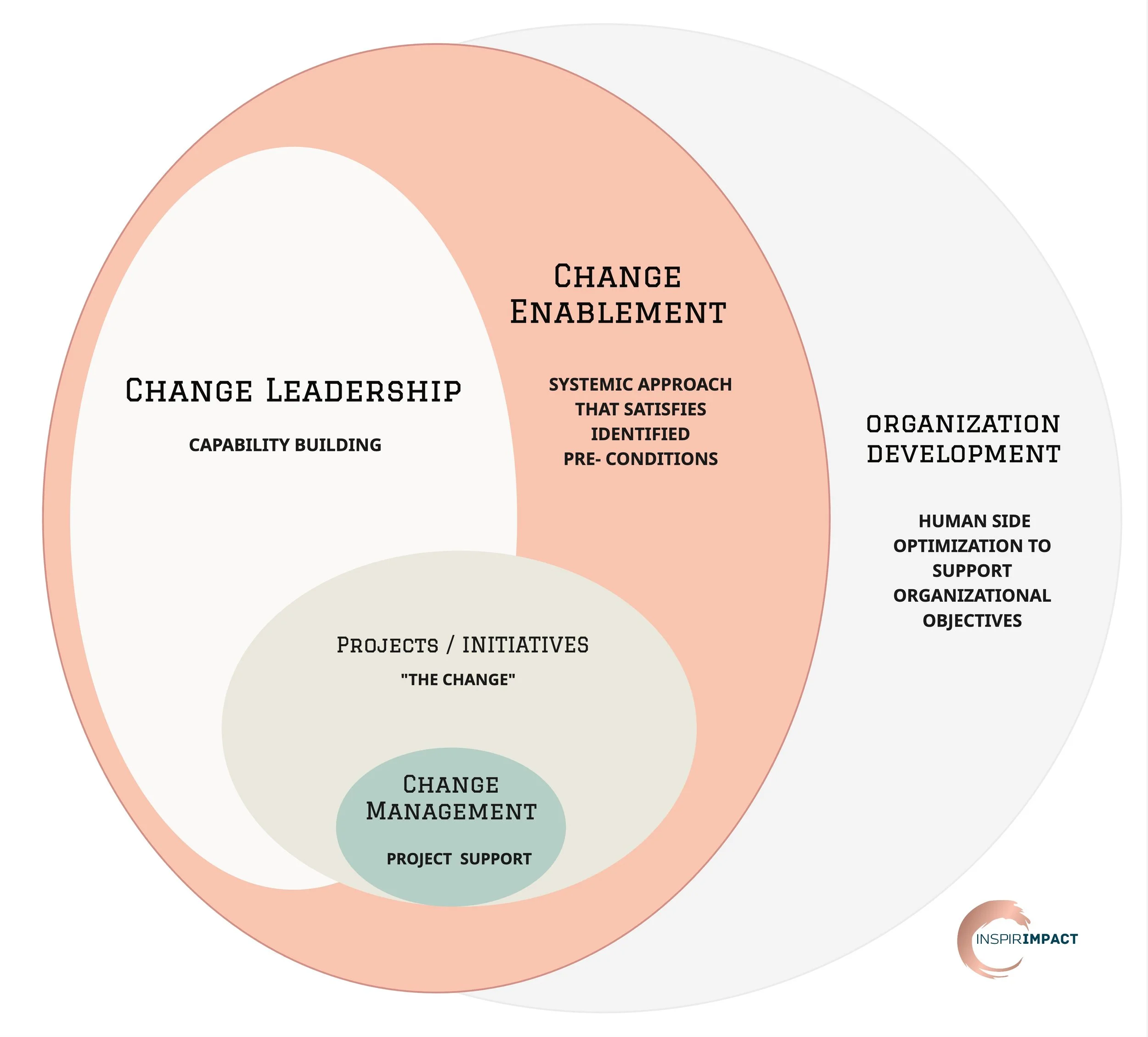
Change Enablement is the evaluation and enactment of the pre-conditions necessary for the desired change to organically and optimally take root.
This is where the term change enablement comes from, I and many other practitioners who operate at this level have started calling our work Change Enablement. We recognize that for any change to have a chance at sustainment, we have to front load the work before the change even passes the first stage gate.
We ask questions like “what pre-conditions are necessary to organically and optimally support the change we are trying to achieve?’ - and then we seek to ensure that not only are those pre-conditions identified, but that we’re also working at the organization system level, generally with leadership and/or organization development, to influence their attainment.
After all, anyone who thinks that discomfort based human behaviour is something to be managed, after the human who is exhibiting such behaviour has been ambushed with something they didn’t ask for - and thinks that the way to manage it is to hammer comms and training into them - is almost certain to fail at sustaining change.
Boundaries between Change Enablement and Organization Development
We live in a reductionist world. We seek to understand things through the study of breaking them down into their elements, and make assumptions on the basis of these - rather than considering the interconnections of these discrete parts, and even more - the way that these discrete parts form a whole.
Western medicine is the best example of this. We might present to the doctor with hair loss, perhaps there are a few others symptoms present as well, but we’ll focus on the most obvious one. We go to our doctor and say “my hair has been falling out - help me'“. The doctor, doing what they have been trained to do will order blood tests first… is it low iron, is it hypothyroidism, is it related to metabolic syndrome? If none of these things is evident, they might send us to a dermatologist who will look at our scalp and do a biopsy. They will then send us on our merry way with a prescription for something if we’re lucky. We might start taking the prescription, only to realize that now the other thing that was previously a minor ailment is now the major. We go back to our doctor and they’ll refer us onwards, and onwards and onwards. Before we know it, we’re seeing a dermatologist, a neurologist, a psychologist, a physiotherapist and a gynecologist — why? Because we’ve taken the human body to be a sum of it’s parts, when it is anything but that. The philosopher Aristotle first observed that a combined whole is something besides (and often greater than) its individual parts - and this has meaning for the reason stated above, and also, because it has implications around emergent change.
Kurt Lewin - The grandfather of Change Management - er -Organization Development
When I was in my masters program, we learned a great deal about Kurt Lewin. (1989-1947). Known as the grandfather of organization development, he’s also universally recognized as the founding father of change management. Irony? I think not.
Lewin’s background was in psychology, and did extensive work within social psychology and applied behavioural science. He was one of the first who studied group dynamics and organization development (OD), which is defined as: the study and implementation of practices, systems, and techniques that affect organizational change, the goal of which is to modify the performance and/or culture of a group or organization. Wait. What?
You heard right. OD is the bedrock upon which organizational change is enabled. If we go back to the very narrow scope of Change Management as it is seen today, Kurt Lewin is almost certainly rolling in his grave.
The field of OD has undergone a bit of a crisis in identity over the past 40 years, and despite it often using terms that alienate the core business (e.g. “Appreciative Inquiry”), it is a critical function within organizations focusing on creating great teams, improving the organization, and developing leaders. There is also, I would argue - no place to debate whether or not OD is more than just change, because the two go hand in glove. They are build off the same foundation, but because as I’ve already noticed, change management these days means something very different, Change Enablement has emerged as a function of OD, bringing together a view on the whole organizational system, including leadership development and coaching — into the conversation of desired organizational improvement (ergo, change.)
From Lewin to Galbraith in 30 years
At this point, I will weave together the point I made about the sum being greater than it’s parts, and OD, and introduce you to the Galbraith Star Model. Developed by Jay Galbraith in the 60’s, the Galbraith Star is often used by Organization Development practitioners, consultants, and Change Enablement folks alike as a diagnostic, alignment and planning tool to systematically design and transform companies. It facilitates the understanding of the interconnectedness of things, and argues that a change to one point of the star, will have ripple effects on the others unless they too are considered. In other words, rather than treating business problems as isolated incidents, the model is often used to both find the root cause of organizational friction and guide restructuring, and, in planning and design of systemic interventions - to avoid creating undue friction at the time of change.
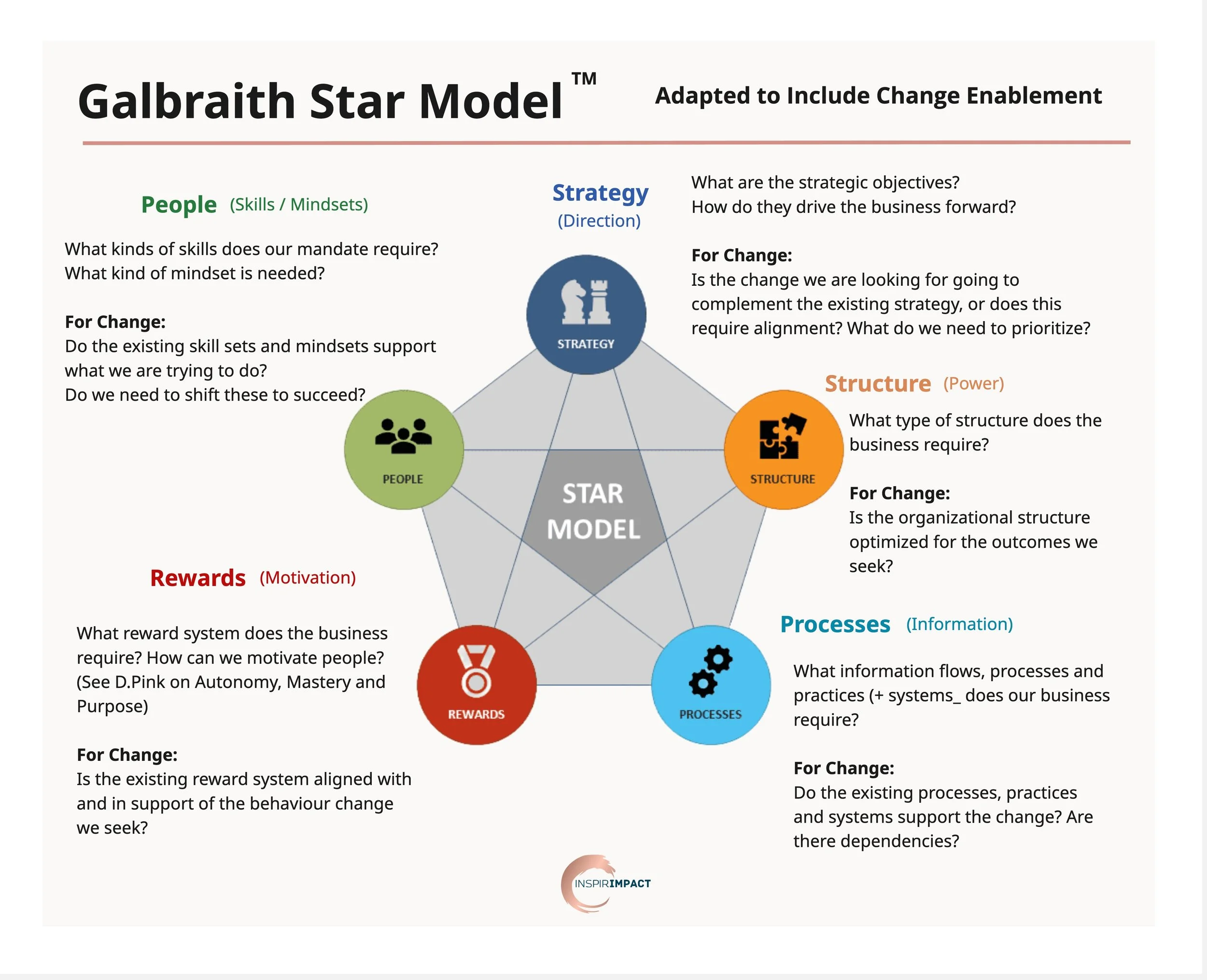
In my line of work, I lean on the Galbraith Star Model frequently. It is potentially, along with the Cynefin framework, one of my absolute strongholds in my Change Enablement Toolkit. Over time using it, as I’ve continued to develop my Change Enablement practice, I’ve adapted the original to include questions specifically targeted at eliciting optimal understanding of what truly needs to be in place for any given organizational change to take hold.
I leverage the model frequently in any transformation or change process I support, because as per complexity theory, and the systemic feedback loop nature of living organisms- we know that any change we bring about, is certain to bring about other changes and oftentimes, unintended consequences. Anticipating this, we structure all change plans in iterative and incremental approaches, and while the change implementation may take longer than the “bulldoze and judge” approach of top down ma-make - it - happen Change Management, it is more responsive to the organizations needs - and results in more organic adoption of lasting change.
Adding Change Enablement into the Organizational Change Landscape Iteratively and Incrementally.
But what about organizations that have Change Management already built in?
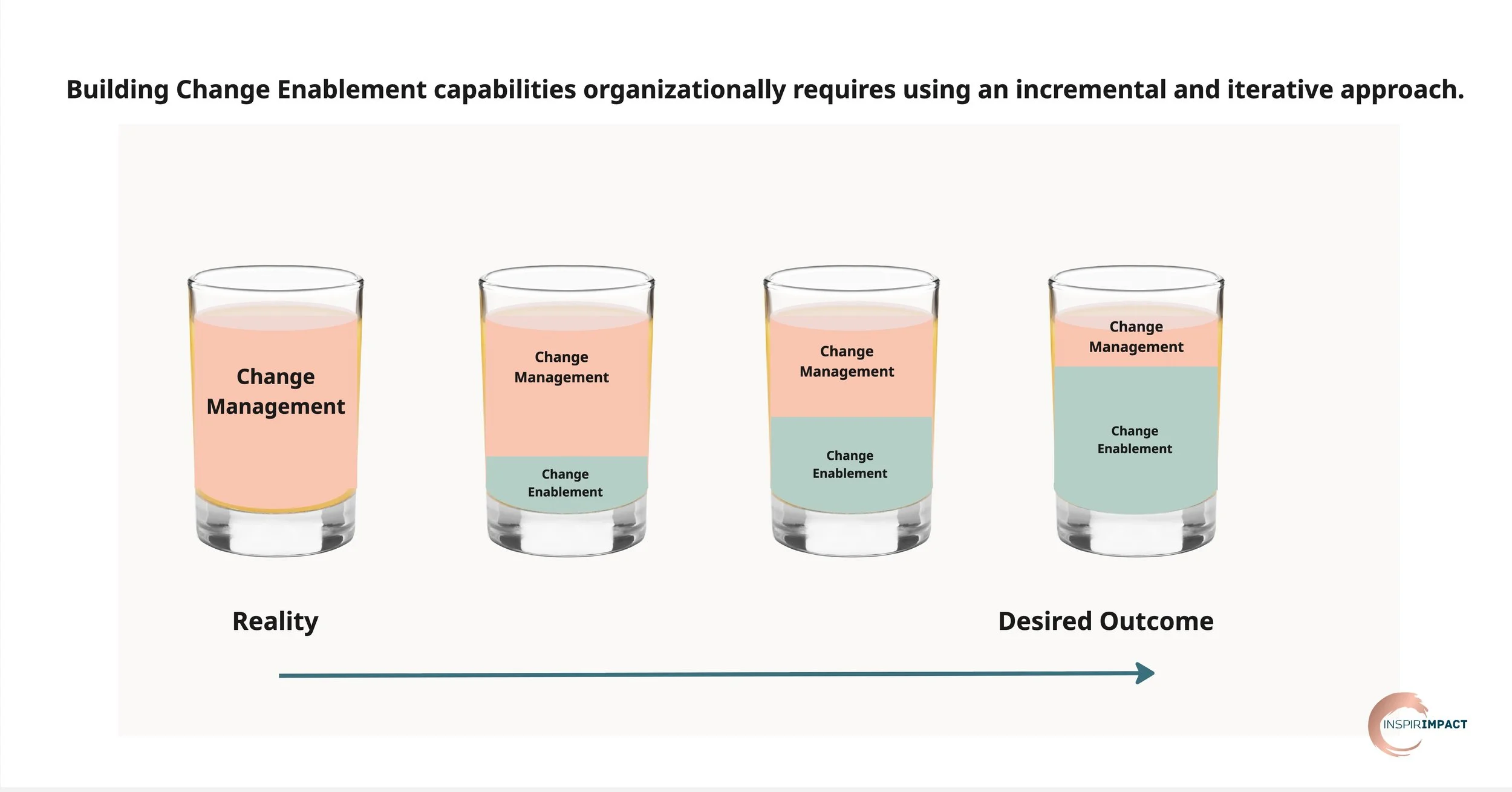
In case my argument has been making it seem that Change Enablement is the only way to do things, and that there’s no space for current Change Management approaches - take heart that this is not the intent. Whether or not we like it, Change Management as a project support discipline is here to stay, even if we might not love the linearity it assumes. The truth is, CE supporting the system, and CM supporting the individual, should work as partners.
Slow and Steady? Or Iterative and Incremental?
For organizations where there is only CM, and not yet CE - the best way to introduce CE is iteratively and incrementally. Organizations are constantly living and evolving organisms, as are the people within them - and if we go back to a previous blog I wrote on Change Resistance (INSERT LINK), the last thing we want to do is go beyond the collective window of tolerance and trigger any threat response. Why work harder if we can work smarter? This is why, the CE philosophy believes in meeting people and organizations where they are, and addressing the system level things that can make change easier. Imagine if we could have an organizational system where we were actively front loading all the work pre-empting resistance, so that we minimized the amount we ran into by the time we got to implementation? That’s what CE seeks to do, and it’s why, the optimal model includes both. Let CE handle the up front system interventions to make subsequent change easier, and the Change Managers will love you - but also - your project will go faster.